
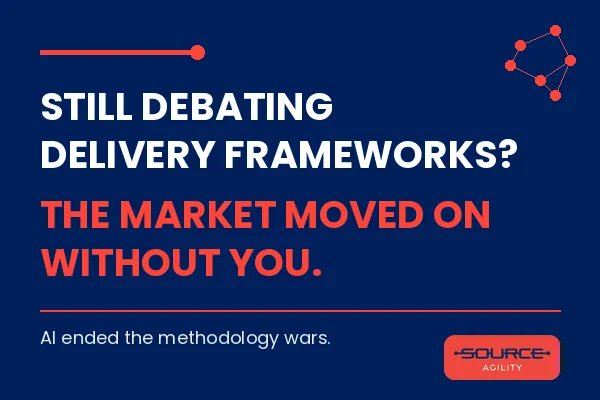
AI Didn't Kill the Waterfall vs Agile Debate. It Made It Irrelevant.
A senior DevOps leader said something to me recently that I can't shake: "AI has created Formula One speed in some parts of our delivery. Meanwhile, other parts of the organisation are still driving a four-cylinder petrol car."
He wasn't complaining. He was genuinely puzzled about how to lead in an organisation where the gap between the fastest and slowest parts is now measured in orders of magnitude, not percentages.
Welcome to the new reality of technology delivery in 2025.
The Old War Is Over (And Nobody Won)
For two decades, we've been fighting about the "right" way to deliver technology. Waterfall versus Agile. Predictive versus adaptive. Plan-driven versus value-driven. The arguments filled conference halls and consulting proposals alike.
Then AI arrived—not as another combatant in the methodology wars, but as something that rendered the entire debate obsolete.
Here's what's happening on the ground: The time from idea to working prototype has collapsed so dramatically that the traditional distinctions between "planning" and "doing" no longer make sense. When a developer can generate functional code in hours that would have taken weeks, when a product manager can prototype a user interface while still in the discovery conversation, when a data analyst can build and test models before the requirements document would have been signed off—the old frameworks simply don't fit.
This isn't hyperbole. I'm watching it happen across the organisations I work with. The question has shifted from "should we use Agile or Waterfall?" to "how do we operate when some teams are moving at AI-augmented speed and others aren't?"
The Real Challenge Nobody's Talking About
Technology vendors want you to believe AI adoption is primarily a technology problem. Buy the platform. Implement the tools. Watch the magic happen.
But the data tells a different story. 95% of AI pilots fail to reach production. Not because the technology doesn't work - but because organisations can't adapt their ways of working fast enough to keep pace with what the technology now makes possible.
Think about that for a moment. The bottleneck isn't the AI. It's us.
The executives I'm speaking with are caught in an impossible position. They're under intense pressure to adopt AI—from boards, from competitors, from vendors with increasingly sophisticated pitches. But they're also navigating a fog of confusion about what's real, what's hype, and what's actually achievable given their organisation's current state.
The honest truth? Most of them don't know which pilot to run next. They're not sure which proof of concept is worth taking to scale. And they're deeply uncertain whether the Big 4 strategy document sitting on their desk - the one that cost a quarter million dollars - is actually a roadmap or just expensive wallpaper.
What AI Is Actually Demanding From Your Delivery System
Here's what I'm learning from being in the middle of this - working with teams that are genuinely trying to make sense of AI adoption while keeping their existing operations running:
AI compresses learning cycles to the point where traditional phase gates become absurd. When you can test a hypothesis in an afternoon that would have taken a quarter to validate, your governance model needs to catch up. The organisations winning at AI have moved from "approve the plan" to "enable rapid experimentation within clear boundaries."
The gap between your fastest and slowest teams is now your biggest delivery risk. That DevOps leader's Formula One versus four-cylinder metaphor? It's not just about speed. It's about integration. When AI-augmented teams need to interface with traditional teams, the friction isn't technical - it's temporal. They're operating on fundamentally different rhythms.
DevSecOps was supposed to be the final evolution. It wasn't. AI is pulling delivery into something even more hyper-iterative. The continuous integration/continuous deployment pipeline that seemed revolutionary five years ago now looks like a starting point, not a destination.
The human factor has never mattered more. Ironic, isn't it? The more AI can do, the more critical human judgment becomes in knowing what it should do. The organisations getting AI right are investing heavily in capability building—not just technical skills, but the adaptive thinking and decision-making that determines whether AI augments human potential or just creates expensive automation.
My Own Learning Curve
I'll be honest: as a consultant and practitioner who's spent years helping organisations navigate Agile transformations, delivery improvement, and operational excellence, I'm having to make sense of this shift while I'm advising others through it.
The difference now is the speed of change and the speed of learning required to stay useful. Every conversation teaches me something. Every organisation reveals a new pattern or breaks an assumption I was carrying.
What I can say with confidence is that the organisations making real progress share some common traits: They're treating AI adoption as a delivery discipline challenge, not just a technology procurement exercise. They're building internal capability rather than outsourcing judgment. They're learning fast and adjusting faster. And they've stopped waiting for perfect certainty before taking the next step.
Where To Start: The One Question That Matters
Through extensive conversations with business leaders - and deep collaboration with colleagues who've led enterprise AI adoption at organisations like King & Wood Mallesons, NAB, and MLC; we've developed a simple tool to help cut through the noise.
We call it the AI Clarity Compass.
It won't give you all the answers. But it will help you identify the one thing that's actually blocking your organisation from adopting AI and taking it to scale. Because in our experience, the constraint is rarely where people think it is. It's not usually the technology. It's not usually the budget. It's almost always something more fundamental about how your organisation learns, decides, and delivers.
What's your biggest blocker to AI scaling right now?
Take 2 minutes to find out: [AI Clarity Compass Link]
The methodology wars are over. The real work—figuring out how to deliver in an AI-augmented world—is just beginning.